

Research
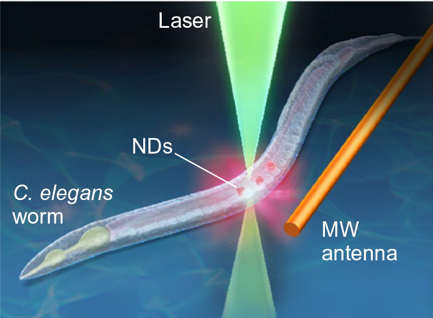
Nitrogen-vacancy (NV) centers in nanodiamonds (NDs) are exceptionally stable, solid-state quantum light sources. By tracking shifts in the optically detected magnetic resonance of an NV center’s electron spin, we can precisely sense changes in local magnetic fields, electric charges, or temperature [1]. Our research explores the ultimate limits of these nanoscale quantum sensors and harnesses them for diverse applications. Working together with researchers from solid-state physics, biophysics, and biology we strive to uncover the hidden dynamics of charge transport at hybrid solid-state interfaces [2] or to probe heat flow at the nanometer scale within biological systems [3], including individual cells and even their internal compartments.
References
[1] Nanoscale magnetometry with NVcenters in diamond, S. Hong, M. S. Grinolds, L. M. Pham, D. Le Sage, L. Luan, R. L. Walsworth, A. Yacoby, MRS Bulletin 38, 155 (2013)
[2] Coupling a single nitrogen-vacancy center in nanodiamond to superparamagnetic nanoparticles, N. Sadzak, M. Héritier, O. Benson, Scientific Reports 8, 8430 (2018)
[3] Real-time nanodiamond thermometry probing in vivo thermogenic responses, M. Fujiwara, S. Sun, A. Dohms, Y. Nishimura, K. Suto, Y. Takezawa, K. Oshimi, L. Zhao, N. Sadzak, Y. Umehara, Y. Teki, N. Komatsu, O. Benson, Y. Shikano, E. Kage-Nakadai, Science advances 6, eaba9636 (2020)
Team: Anja Jovicevic, Zeeshan Nawaz Khan, Wanrong Li
Partners: Okayama Univ., Japan; members of IZ Life in Space & Time, LIST
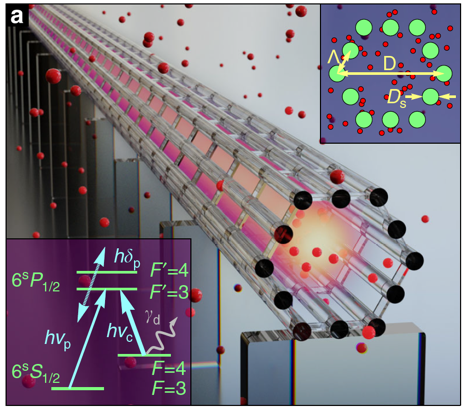
Having entanglement between physically distinct systems is a relatively unexplored frontier in quantum physics [1]. We aim to connect alkali atoms in gas cells with semiconductor quantum dots or other solid-state emitters through photon-mediated interactions. By employing light-confining structures, such as optical fibers or light cages, that enhance these interactions [2], we can generate novel quantum states that may enable new approaches in quantum sensing and quantum information processing. Additional applications in quantum technologies, including quantum memories [3], photon synchronizers, and photon sources [4], can benefit from hybrid quantum elements that combine the superior properties of their constituent systems.
[1] Hybrid integrated quantum photonic circuits, A. W. Elshaari, W. Pernice, K. Srinivasan, O. Benson, V. Zwiller, Nature photonics 14, 285-298 (2020)
[2] Davidson-Marquis, E. Gómez-López, B. Jang, T. Kroh, C. Müller, M. Ziegler, S. A. Maier, H. Kübler, M. A. Schmidt, O. Benson, Light: Science & Applications 10:114 (2021)
[3] Light Storage in Light Cages: A Scalable Platform for Multiplexed Quantum Memories, E. Gómez-López, D. Ritter, J. Kim, H. Kübler, M. A. Schmidt, O. Benson, arXiv:2503.22423
[4] Slow and fast single photons from a quantum dot interacting with the excited state hyperfine structure of the Cesium D1-line, T. Kroh, J. Wolters, A. Ahlrichs, A. W. Schell, A. Thoma, S. Reitzenstein, J. S. Wildmann, E. Zallo, R. Trotta, A. Rastelli, O. G Schmidt, O. Benson, Scientific reports 9, 13728 (2019)
Team: Esteban Gomez Lopez, Hala Said, Jasper Leonard Glindemann
Partners: Univ. Würzburg; IPHT Jena
[1] Production and applications of non-Gaussian quantum states of light, A. I. Lvovsky, Philippe Grangier, Alexei Ourjoumtsev, Valentina Parigi, Masahide Sasaki, Rosa Tualle-Brouri, arXiv:2006.16985 (2020)
[2] Non-Gaussian Quantum States and Where to Find Them, Mattia Walschaers, PRX Quantum 2, 030204 (2021)
[3] Integrated photonic source of Gottesman-Kitaev-Preskill qubits, M. V. Larsen et al., Nature 642, 587-591 (2025)
Team: Elnaz Bazzazi, Gao Chao, Roger Alfredo Kögler, Marco Schmidt
Partners: FU Berlin; AIST, Japan; PTB
[1] Solid-state single-photon emitters, I. Aharonovich, D. Englund, M. Toth, Nature Photon 10, 631–641 (2016)
[2] Bright source of indistinguishable photons based on cavity-enhanced parametric down-conversion utilizing the cluster effect, A. Ahlrichs, O. Benson, Applied Physics Letters 108, 02111 (2016)
[3] Quantum computing with photons: introduction to the circuit model, the one-way quantum computer, and the fundamental principles of photonic experiments, S. Barz, J. Phys. B: At. Mol. Opt. Phys. 48, 083001 (2015)
[4] Hybrid integrated quantum photonic circuits, A. W. Elshaari, W. Pernice, K. Srinivasan, O. Benson, V. Zwiller, Nature photonics 14, 285-298 (2020)
Team: Ralf-Peter Braun, Siavash Qodratipour, Thomas Häffner, William Staunton
Partners: Telekom T-Labs; Univ. Paderborn
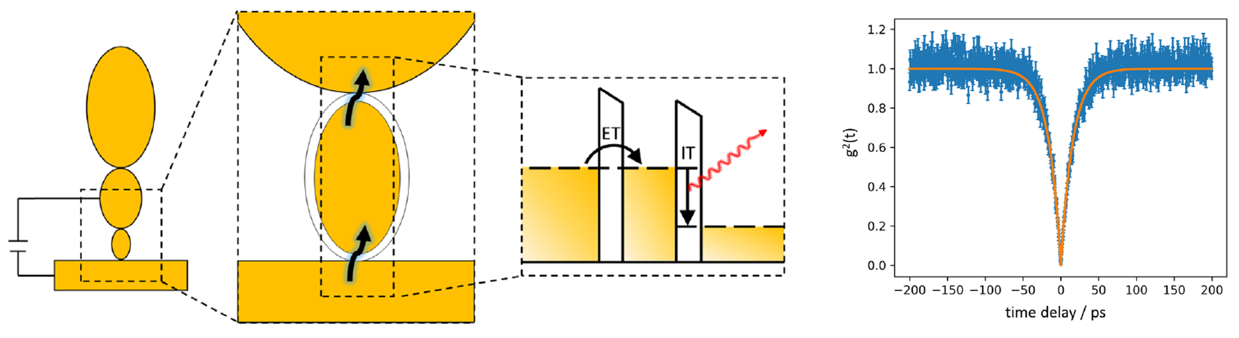
[1] Special issue on quantum plasmonics, eds. Z., F. J. Garcia-Vidal, E. Potma, J. Optics 18 (2016)
[2] Optical spectra of plasmon–exciton core–shell nanoparticles: a heuristic quantum approach, F. Stete, W. Koopman, C. Henkel, O. Benson, G. Kewes, M. Bargheer,
ACS Photonics 10, 2511-2520 (2023)
[3] Proposal for a Tunable Room-Temperature Single-Photon Source Based on a Plasmonic Nanoantenna Driven by Inelastic Tunneling in the Coulomb Regime, G. Kewes and O. Benson, Phys. Status Solidi A 221, 2300366 (2023)
Team: Bendix Hartlaub, Günter Kewes
Partners: Okayama Univ., Japan